Book
A Fire Upon the Deep
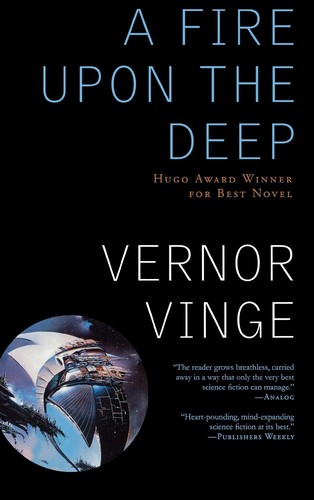
The premise is the hook here and it’s a genuinely great one, a galaxy divided into zones where the rules of intelligence and technology change depending on how close you are to the core. Deep enough in and faster-than-light travel and true AI are simply impossible, out at the edges godlike transcended minds are almost routine. Vinge, a computer science professor before he was a novelist, uses that structure to ask what a technological singularity actually looks like from the outside, and it works better as a novel than that description makes it sound.
The Tines are the reason to read this. A species that exists as four to eight individual wolves operating as one mind per pack, and Vinge handles the logistics of that, communication, distance, what happens when a pack member dies mid-conversation, with a level of care that never feels like homework. I found myself more invested in the medieval-tech dog packs scheming against each other than in most of the human cast, which says something about where the book’s real energy sits.
Where it thinned out for me was the human side, Ravna especially, who’s carrying a lot of plot without getting the interior life to match, and Pham’s arc lands as tragic more because the plot needs it to than because I felt it building. The Blight itself, a self-aware weapon wiping out planets, stays more abstract than horrifying, which cost the book some of its stakes for me. Still, the sheer scope, the USENET-style computer network chatter woven through as texture, and the Tines alone make this one of the better hard science fiction reads I’ve had this year. Four stars, would’ve been five with a stronger human half.
#books #4outof5 285 words